Dining Room Planning
How to Choose an Extension Dining Table for Everyday Living
An extension table is a small exercise in domestic foresight: compact enough for an ordinary Tuesday, generous enough for the evening when Tuesday acquires unexpected guests. Choosing well means looking beyond the moment the leaves are open. The table must also fit the room, welcome chairs, allow people to move about, and feel right when it is carrying nothing more consequential than breakfast.
There is a particular optimism in buying a dining table that grows. One imagines a holiday meal, a birthday, a long afternoon in which nobody checks the time. Yet the table will spend most of its life in its everyday form, accommodating familiar plates and familiar routines. The practical question is not simply how large it becomes, but whether it works beautifully before, during, and after company.
Extension dining tables answer a real problem in many homes: the dining room is not always a room devoted exclusively to dining, and a table large enough for every possible gathering can dominate the space on an ordinary day. A leaf, or several leaves, lets the footprint change with the occasion. The right choice balances that flexibility against the less theatrical but more frequent demands of room planning, seating comfort, construction, and care.
Begin with the room, not the table
It is tempting to begin with a shape or a finish. Begin instead with the floor. Measure the dining area, including the paths people use to enter and leave it. Note door swings, radiators, built-ins, windowsills, and any furniture that is likely to remain in place. A table can be handsome in isolation and awkward in a room; the room, after all, will be the table’s daily companion.
Measure the space with the table closed and fully extended. If the design has more than one extension configuration, record the dimensions for each. Then add the chairs. A dining table is not merely a top with legs: when occupied, it is surrounded by bodies, chairs pulled back from the edge, and people moving between the table and the rest of the house.
A useful planning principle is to leave roughly 36 inches between the table edge and a wall or other obstruction where people need to sit and move. More room—about 42 to 48 inches—can make circulation feel easier, especially on a busy route or in a room used by several people at once. These are starting points rather than laws. The best test is to mark the proposed footprint on the floor with painter’s tape and place chairs around it. Then walk the route. Sit down. Pull each chair back. The tape is inexpensive; discovering the problem after delivery is not.
Check clearance around the extended table, too. A table that fits comfortably when closed may become a barricade when its leaves are in place. Pay particular attention to the route to the kitchen, a nearby doorway, or the seat that is hardest to reach. Consider whether the expanded table will block a cabinet or prevent someone from passing behind a seated guest. If the table will be extended only a few times a year, that may be an acceptable compromise. If the room is used for larger meals every week, it may not be.
Choose a shape that suits the floor plan
Rectangular tables are the familiar solution for a reason. They make effective use of long rooms and can usually be placed parallel to a wall, a window, or the dominant axis of the space. Their straight edges also make it relatively simple to judge the amount of floor they occupy. When extended, a rectangular table gains length without changing its basic geometry, which can be useful when a room has a clear direction and a defined dining zone.
The trade-off is that corners take up space. In a narrow room, a rectangle can make movement around the ends feel pinched, particularly if chairs are placed close to a wall. A narrower top may ease circulation, but it should still provide enough surface for place settings and shared serving dishes. As you compare dimensions, think not only about how many people might sit down but also about what happens in the middle of the table: a modest centerpiece, a platter, or the collection of bowls that appears once dinner is underway.
Oval tables soften the room’s geometry. Their rounded ends can make it easier to move around the table, and they avoid the sharp corners of a rectangle in tighter circulation areas. An oval may be especially appealing in a room that already contains several straight lines or has a more open, informal arrangement. Its shape also encourages conversation across a less rigid outline, though the precise seating capacity depends on the table’s dimensions and leg placement.
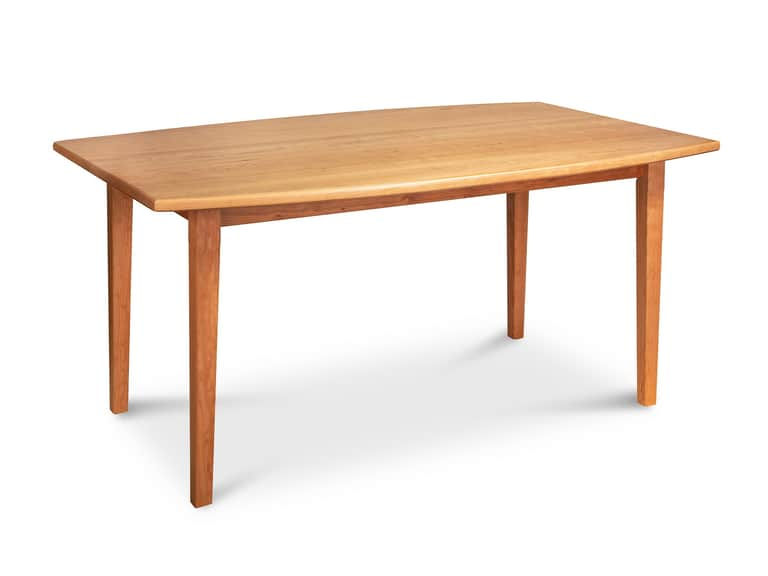
Boat-shaped tops, with gently tapered ends, offer a related effect. They bring some of the visual softness of an oval while retaining a substantial central area. The Vermont Shaker Boat Shaped Solid Top Dining Table, for example, pairs a boat-shaped surface and boat edge with four-sided tapered legs. It is handcrafted in Vermont from sustainably harvested solid wood. Its shape may suit a household seeking a distinctive outline without a heavily ornate profile, but its suitability still depends on measured room clearances and the seating arrangement.
Round tables can be appealing in compact, square rooms because they have no corners and can make conversation feel naturally inclusive. They are not always the most efficient choice for a long room, however, and their diameter can grow quickly as seating needs increase. Extension mechanisms for round tables may create an oval when opened, so consider the table in both forms. The expanded shape may be the one that ultimately determines whether it works in the room.
Think carefully about the leaves
The extension mechanism is where an adaptable table earns its keep. Leaves may be stored separately, housed within the table, or added to one or both ends, depending on the design. There is no single arrangement that suits everyone. What matters is whether the system matches the household’s space, habits, and tolerance for a little furniture choreography.
A self-storing leaf has an obvious convenience: the pieces needed to extend the table stay with it. That can spare a closet or basement corner from becoming a leaf archive. But inspect how the leaf is stored and whether the table’s internal mechanism affects its weight or design. A separate leaf, by contrast, may allow a simpler table structure, but it needs a safe, dry place when it is not in use. A leaf leaning in a crowded closet is a future inconvenience that can be anticipated now.
Ask how the table opens. Does the top separate smoothly? Can one person manage the operation, or is it more practical with a second pair of hands? Does the leaf sit flush when installed? Are the seams discreet and stable? These questions may sound almost aggressively practical, but a mechanism that is awkward to use is less likely to be used. If gatherings are part of the plan, request a demonstration where possible, or review the manufacturer’s instructions before committing.
Consider the number and size of leaves. One 18-inch leaf, such as the one included with the Vermont Shaker Oval Extension Dining Table, offers a straightforward increase in length. Other tables can accept leaves at one or both ends, allowing different expanded sizes. More configurations can provide welcome flexibility, but they also add decisions: where the leaves will live, how often each arrangement will be used, and whether the room can accommodate the largest version.
Leg placement matters particularly when a table is extended. A pedestal base can leave more freedom for chairs, while conventional legs may define where seats can comfortably go. On a rectangular table, the corner positions can be affected by the legs, apron, or extension hardware. When the table is open, guests should not find themselves straddling a support or competing for the one place with adequate knee room. Check the dimensions between legs and the underside of the apron—not just the length and width of the top.
Estimate seating with a little humility
Manufacturers often describe a table in terms of the number of people it can seat. That number is useful, but it is not a guarantee of comfort. The width of the chairs, the amount of elbow room people prefer, and the kind of meal being served all matter. A quick supper can be arranged more tightly than a long dinner with serving dishes passed around. A bench may change the calculation again.
As a rough guide, allow about 24 inches of table edge per person for a comfortable place setting, adjusting for chair width and the shape of the tabletop. End seats can add capacity, though they may be restricted by the table’s legs or by the head of an oval. Before choosing, sketch the seats around both the closed and extended table. This helps reveal whether the extra length creates genuinely useful places or merely a larger surface.
Benches are sometimes a practical companion to extension tables, particularly in informal dining areas where flexible seating is welcome. The Modern American Bench is made in Vermont from solid cherry, maple, or walnut and has a clean, contemporary profile. A bench can be tucked under a table when not in use and can accommodate a shifting number of people, but it should be checked for suitable height, depth, and leg clearance. It does not automatically make every table more comfortable; the proportions must agree.
Materials and finishes: the long view
Material changes how a table looks, feels, and ages. Solid wood has a presence that can make a dining room feel settled without making it formal. Cherry, maple, and walnut each have their own grain and color, and natural finishes tend to let those differences remain visible. Color and grain vary, too, even within the same species. If consistency with existing furniture is important, ask how the selected wood and finish are expected to develop over time rather than judging only by a small sample.
Wood is not immune to daily life. Plates, cups, sunlight, temperature changes, and the occasional hurried wipe all leave their marks. A finish helps protect the surface, but care instructions differ. An oil finish may bring out the grain and invite periodic maintenance, while a more protective topcoat may offer a different balance of feel and resistance. Ask what cleaners are recommended and whether the maker advises using trivets, placemats, or prompt attention to spills. The object is not to treat a dining table as an exhibit, but to understand how it will respond to actual meals.
Durable construction also matters beneath the surface. A sturdy frame, well-fitted joints, properly supported leaves, and a stable leg-to-apron connection contribute to a table’s daily usefulness. A heavy top is not, by itself, proof of quality, and a light one is not necessarily a failing. Look for clear information about materials, joinery, extension hardware, and how the tabletop is supported in its closed and expanded forms.
Solid wood tables made to order may require a longer lead time than mass-produced alternatives. That can be an advantage if it allows a choice of wood or dimensions, but it requires planning. Ask about the production schedule, delivery, assembly, and the procedure for carrying the table into the room. A table that fits the dining area but cannot pass through the stairwell has a very particular kind of mismatch.
Measure for chairs and everyday movement
Chairs are often chosen after the table, though it is wise to consider them together. Seat height, armrests, overall width, and the shape of the back can determine whether a chair tucks under the table or competes with the apron. Armchairs need additional clearance at the ends and may not fit comfortably along every side. If you already own chairs, measure them. If you plan to buy new ones, compare their dimensions with the table’s underside and the space available around it.
Think of clearance as more than an empty margin. It is what lets someone get up without asking the person behind them to move. It is the space in which a child can push back a chair, a host can carry a dish, or a guest can pass without turning sideways. In a small dining room, these ordinary acts are often more revealing than a floor plan.
Where possible, test the arrangement at home with paper, tape, or movable chairs. Mark the table’s footprint, then add the extended dimensions. Place chairs at their approximate locations and pull them out as though someone were sitting down. Walk between the furniture and the wall. If the route feels uncomfortable in a mock-up, it is unlikely to become more pleasant once the table arrives.
Match the table to the household’s rhythm
How frequently will the table be extended? A household that hosts often may want a mechanism that is quick to operate and leaves easy access to the stored leaf. A family that expands the table only for major gatherings may be content with separate leaves stored elsewhere. If the dining area doubles as a homework station or work surface, a solid, dependable everyday size may matter more than maximum capacity.
It is worth being candid about the events that actually happen. A table chosen for an imagined crowd can consume valuable floor space all year. On the other hand, a cramped everyday table may make hosting feel like a logistical exercise. A useful rule is to choose for the room as it is most often used, then confirm that the extended arrangement works for the occasions that justify it.
Household routines also shape the best surface. A table used for meals, crafts, work, and games will face a wider variety of wear than one reserved for dinner. Consider whether the chosen finish suits that pattern and whether the table’s dimensions can serve multiple purposes without turning the room into a permanent obstacle course.
A practical comparison checklist
When comparing extension dining tables, write down the answers to a few questions. The list need not be elaborate; it should simply make competing options easier to judge on the same terms.
- What are the table’s closed and fully extended dimensions?
- How much clearance remains for chairs and circulation in both configurations?
- What shape best suits the room: rectangular, oval, round, or boat-shaped?
- How many leaves are included, and how are they stored?
- Can the extension mechanism be operated comfortably, and does the leaf sit level?
- Where are the legs, and how do they affect seating and knee room?
- What woods and finishes are available, and how should they be maintained?
- What is the expected lead time, and how will delivery and assembly work?
These questions are not a substitute for taste. They make room for it. Once a table has passed the tests of proportion, use, and construction, the decision can return to the pleasure of choosing a shape and material you want to live with. A restrained Shaker profile may feel quietly at home in a room already shaped by natural wood and clear lines. A more sculptural boat-shaped top might give the dining area a focal point without resorting to ornament. The right answer is less a matter of fashion than of fit.
The table in its ordinary life
An extension table is at its best when its special feature does not overshadow its everyday purpose. Closed, it should leave enough room to move and enough surface for a normal meal. Open, it should create places people can occupy comfortably, not simply add inches to a product specification. Its leaves should be manageable, its legs should respect the seating plan, and its finish should suit the life taking place around it.
Measure both versions. Consider the room’s shape, not merely its area. Check chairs, leg placement, leaf storage, and the path between the dining area and the rest of the home. Then consider how often the table will actually be expanded. A table selected with those ordinary details in mind can handle the occasional crowded evening without making every quiet meal feel like an event staged around furniture.
That is the modest promise of a well-chosen extension dining table: not that it will transform a household, but that it will be ready when the household grows for an evening. The extra leaf waits, the chairs come out, and the room makes a little more space. On most days, the table simply stands where it belongs.